




TRP EVO12 and TRP Slate EVO in Review
19.03.25 11:49 4.3922025-03-19T11:49:00+01:00Text: Erwin Haiden (translated by AI)Photos: Erwin Haiden (Studio), martinbihounek.com (Action)Classical concert instead of heavy metal: The new battery-free shifting group and a beginner-friendly brake with pleasant power transmission in a double review.19.03.25 11:49 4.5562025-03-19T11:49:00+01:00TRP EVO12 and TRP Slate EVO in Review
19.03.25 11:49 4.5562025-03-19T11:49:00+01:00 Erwin Haiden (translated by AI) Erwin Haiden (Studio), martinbihounek.com (Action)Classical concert instead of heavy metal: The new battery-free shifting group and a beginner-friendly brake with pleasant power transmission in a double review.19.03.25 11:49 4.5562025-03-19T11:49:00+01:00

In times of advancing motorization and electrification of the common biker along with their bicycle fleet, new, analog, and purely mechanical drivetrains are almost a statement – something like a counter-movement to the massive transmission systems of the last generation with their batteries, accumulators, and bulky appearance.
With a purely mechanical but correspondingly modern derailleur featuring a cable and conventional derailleur hanger like the TRP Evo12, the functionality is open and comprehensible, from the shifter through the cable to the derailleur. While this does come with certain disadvantages, such as the susceptibility of the cables to dirt, issues that arise can, in most cases, be resolved without a laptop and diagnostic software – which is always an advantage on the trail.
One of the most feared expressions in modern times is 'The computer is down.
Norman R. Augustine

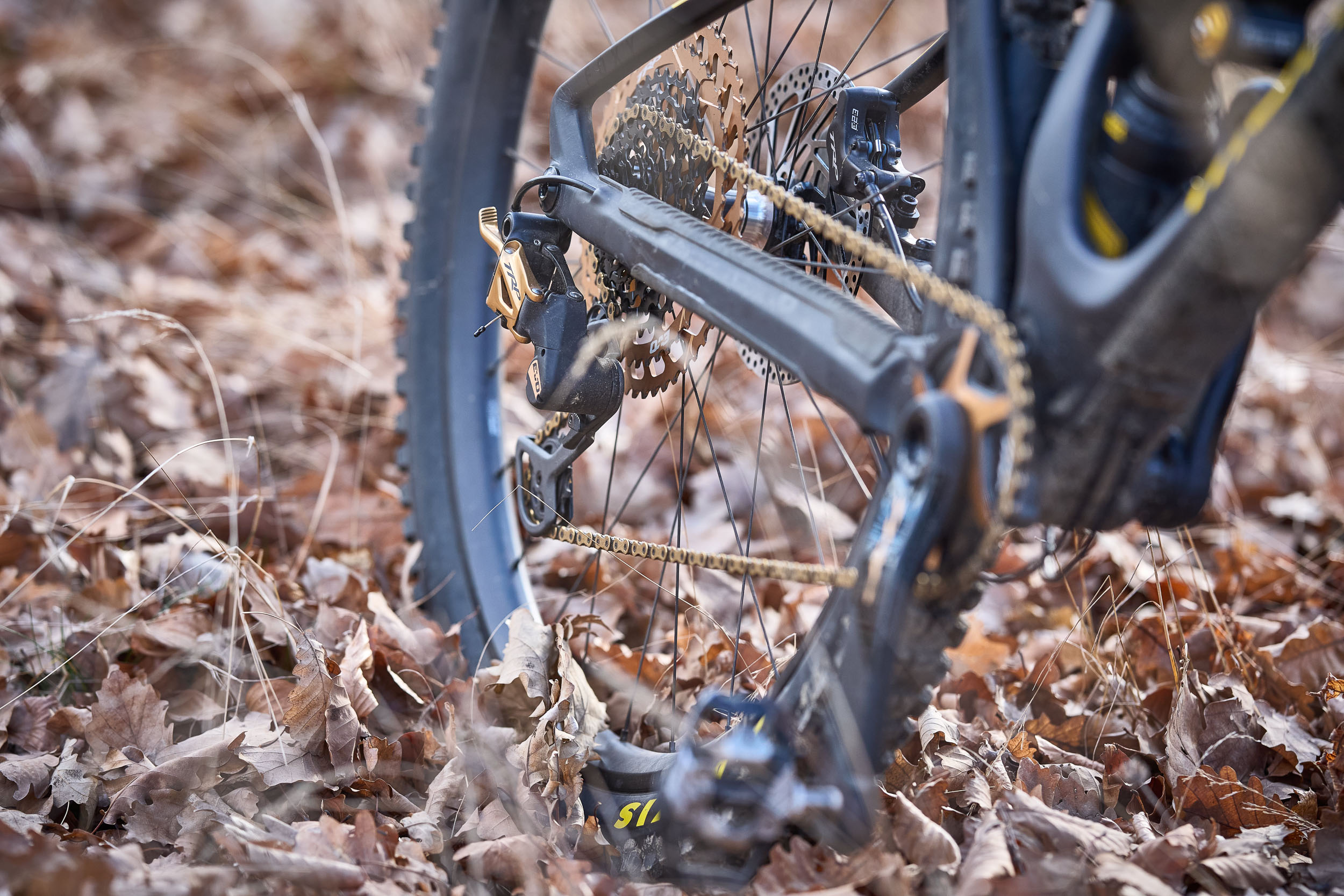


The logical counterpart to the efficient Evo12 drivetrain is the Slate Evo brake, also from TRP, but unlike the drivetrain, it’s not a high-end component, but rather positioned at the other end of the spectrum.
After NoPain already conducted a short review of the TRP Slate Evo on an e-bike some time ago and had nothing to complain about, I wanted to give the entry-level group a chance on the sexy Mondraker Foxy. Since the brake comes with 2.3 mm rotors, I decided to experiment with a 180 mm rotor on the front.
How the two components performed on the trail, you’ll find out after a brief dive into the technical details.

TRP Evo12 groupset
The Evo12 is the second edition of the TRP drivetrain and the direct successor to my old but reliable TR12. With the Evo12, TRP also offers, for the first time, a complete group from the crankset to the cassette, including all relevant parts.
As much as I love my electronic GRX Di2 on the gravel bike, I enjoy riding traditionally mechanical on the mountain bike – with a derailleur hanger that can be easily replaced or aligned after rock contact, and with cables that work independently of batteries and are generally easy to adjust and correct.
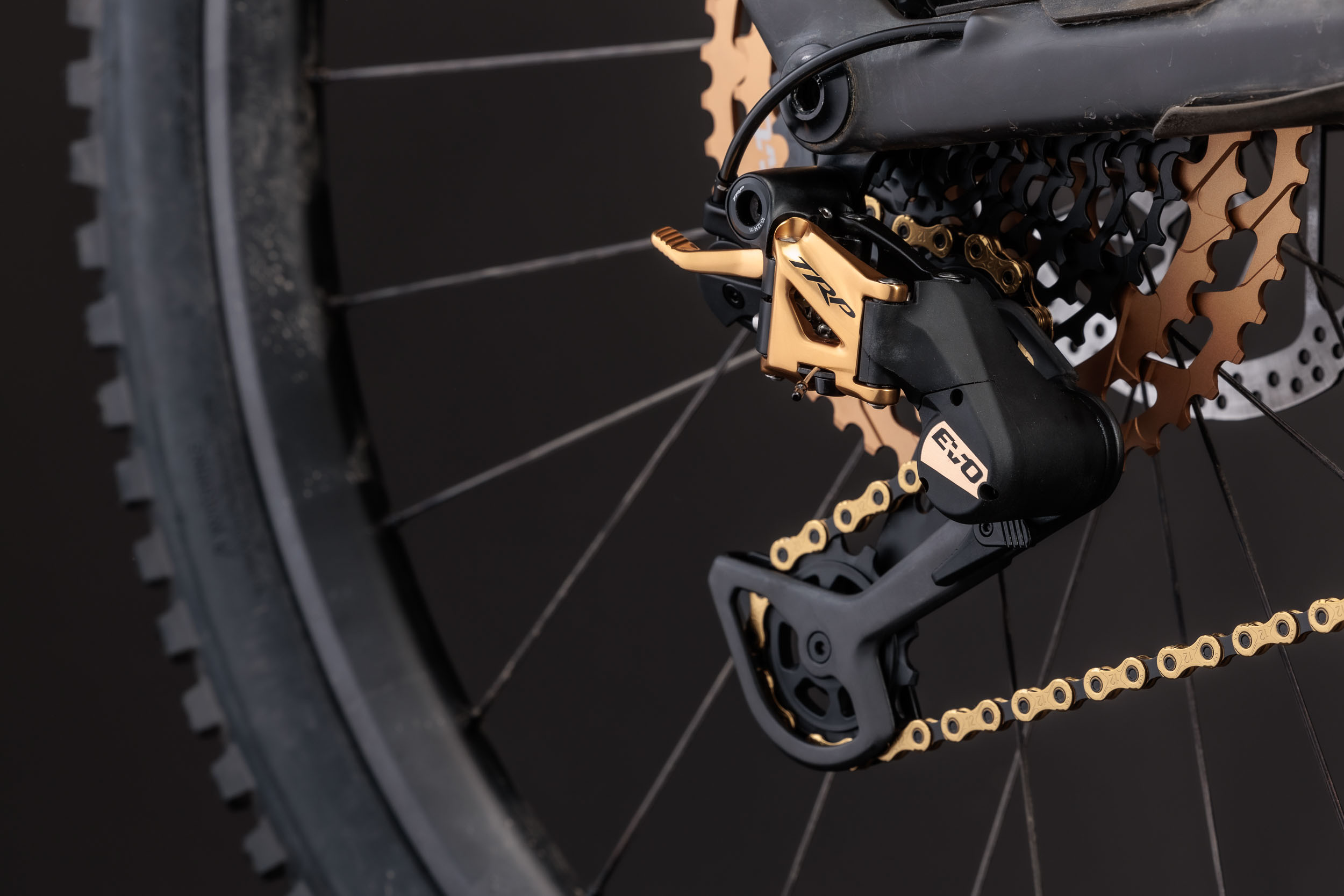
The new Evo12 offers some improvements compared to its predecessor, which are especially visible on the derailleur and shifter. For instance, Aaron Gwin's mechanic, John Hall, is the namesake of the so-called Hall-Locks: The mechanism, which can be activated via a lever, locks the derailleur in position at the mounting point, minimizing unwanted movement and noise. The clutch has also been revised, so it now operates silently. Additionally, the clutch's strength can be adjusted. More on this in the review.


The Evo12 shift lever has also been improved. New is the shift mode switch, which allows you to choose whether to shift up to four gears or just one gear when shifting up.
The widely adjustable Advance lever was already an advantage with the TR12. Even after the first shifting attempts while setting it up and then on the trail, it was noticeable that the shifting performance has significantly improved compared to the TR12 and requires noticeably less finger force.
How the Evo12 performs in the long run will be revealed after the end of the season in late autumn.
| Evo12 Derailleur | + Integrated Hall Lock lever + Horizontal suspension between clutch and B-knuckle + New, silent clutch + Cage release + Outer cage made of carbon fiber + 12T/14T jockey wheels with sealed bearings + Colors: Gold and Silver |
| Evo12 Shifter | + Improved ergonomics + Integration with brake lever + Adjustable advance lever + Clean cockpit routing + Shift mode switch + Colors: Gold and Silver |
| Evo12 Cassette | Microspline™-compatible + 10-52T + 10-11-13-15-18-21-24-28-32-36-44-52 + Two large aluminum sprockets + Monoblock steel gears + Colors: Gold and Silver |
| EVO12 Crankset | + High-performance layup + 30 mm spindle diameter + Lengths: 165 mm and 170 mm + Colors: Gold and Silver + Chainring with Wave Technology |
| Prices (MSRP) | + Derailleur: €269 (€259 in silver) + Shifter: €119 (€109 in silver) + Cassette: €459 (€439 in silver) + Chainring: €89 + Carbon crankset: €389 + Chain: €89 (€49 in silver) + Bottom bracket: €49 (PF or BSA) |




TRP Slate Evo
The Slate Evo brake is essentially the entry point to TRP's Evo series (featuring Slate, Trail, and DHR), and this is my first time riding the brake over an extended period.
Compared to the TRP DHR Evo, the Slate looks more traditional, reminiscent of Shimano's XT, and features calipers that appear elegant and organic.
All rotors in the line share the 2.3 mm (extra) thick brake disc. The additional material provides greater heat storage capacity, which means, on the one hand, that the brake heats up less quickly during hard braking maneuvers. On the other hand, the extra-thick discs are less prone to warping and therefore rub less frequently.
Following the recommendation of NoPain, who briefly tested the Slate on an e-bike, I opted for the 180 mm disc and was curious to see how it would perform on long downhills.
Additional advantages of the Slate Evo include the tool-free reach adjustment, the fairly solid reservoir size for hopefully high durability during long maintenance intervals, and last but not least the use of mineral oil, which I personally find much easier to handle compared to DOT brake fluid.
| Application Area | E-MTB / All Mountain / Touring |
| Material | Die-cast / Forged Aluminum |
| Brake Caliper | 4-Piston Stainless Steel |
| Brake Lever | Ergonomic Design 1-2 Finger Lever / Aluminum |
| Reach Adjust | tool-free |
| Oil | Performance Mineral Oil |
| Brake Line | TRP 5 mm |
| Banjo Fit | Banjo connection for easy and flexible cable routing |
| Brake Pads | Blue: organic - Copper: metallic (optional) |
| Brake Rotors | 2.3 mm thick |
| Sizes 6-Bolt | 180/203 mm |
| Sizes Centerlock | 160/180/203 mm |
| Shifting Integration | Adapter: HD3.3/I-spec II HD3.4/ I-spec EV HD4.1 |
| Mounting Standard | Direct Mount |
| Adapter | Post Mount |
| Price | € 149,- RRP |


Uphill on the trail
Let's start with the Slate Evo brake and the question: What could possibly go wrong with a brake when riding uphill? At the latest, after the first thousand meters of elevation gain with a grinding, chirping, tweeting, or croaking brake rotor, even the most experienced marathon riders and XC riders lose their nerves.
Thanks to the smaller 180 mm rotor, but not least due to the 2.3 mm thickness, this is not an issue with the TRP Slate Evo.
Of course, the more exciting question is how the drivetrain performs, and after numerous rides, I am a declared fan of the Evo12. The ergonomics of the lever can be well adjusted thanks to a wide range of adjustments. Gear shifts are immediate, crisp, and precise, perfectly complementing my bio-bike.
A Sram AXS shifts noticeably smoother due to its electronic tuning in comparison, but this makes it feel a bit mushier on the bio-bike because, depending on the timing of the button press, there is often a split-second delay. Not so with the TRP, where the derailleur is physically connected to the lever via a shift cable, executing gear changes without delay, regardless of whether under load or while coasting.


High-end product at a high-end price with all the benefits of pure mechanics
TRP Evo12 drivetrainSome time ago, I was able to test the electronic shifting system from TRP with A12 E.A.S.I, including the automatic mode and RollShift. However, I have to say: aside from e-bikes, gravel bikes, and road bikes, I am still a big fan of mechanical shifting systems and simple solutions.
Since the first Di2 shifting systems on MTBs over ten years ago, a lot of time has passed. Nevertheless, this indescribable feeling has stayed with me. The physical connection of the legs to the sprocket and the fingers to the derailleur feels better on an MTB—perhaps due to the various situations and force influences in off-road terrain—than with an intermediary computer.


Downhill on the trail
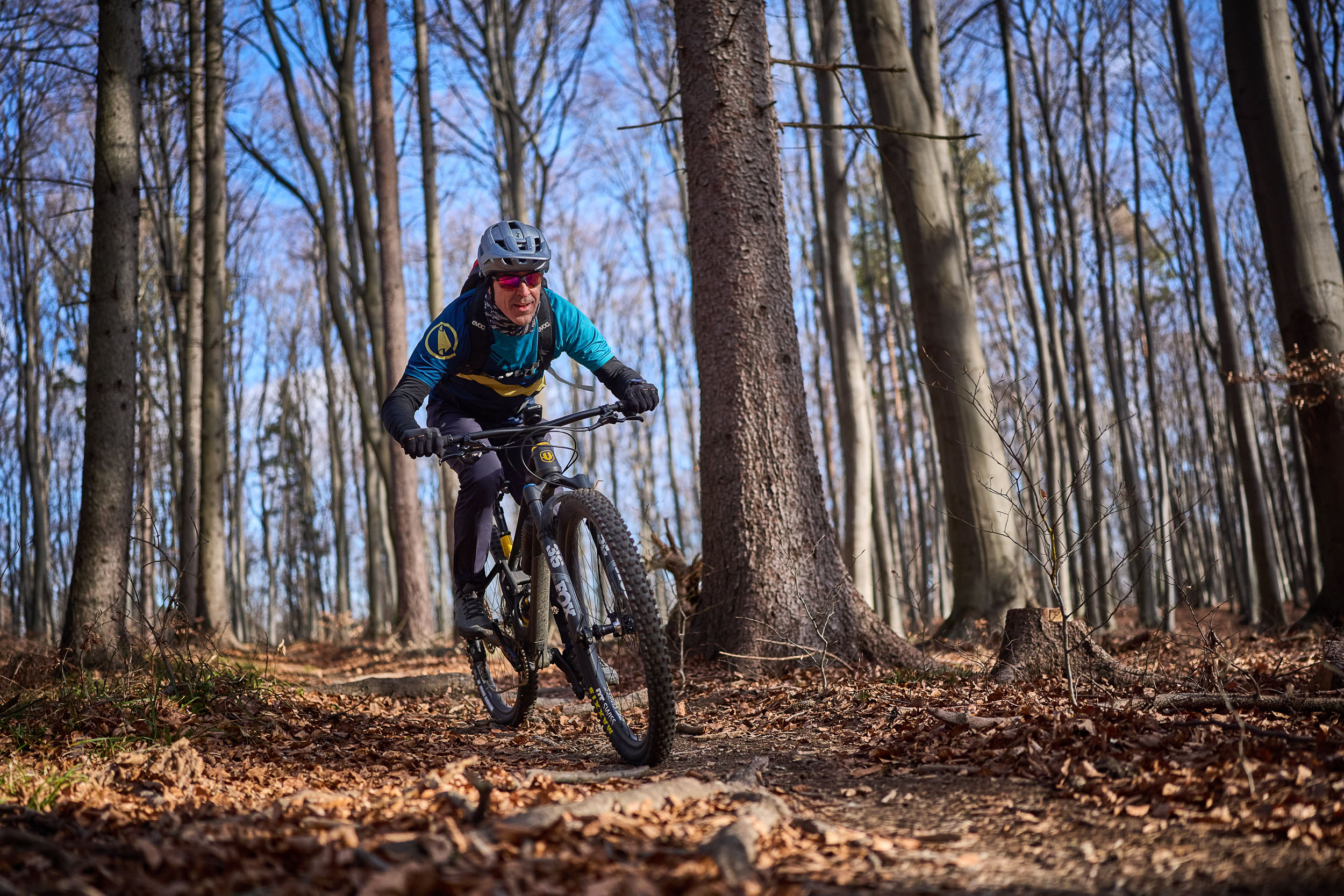
Once properly bedded in, the Slate Evo is not unlike the XT variant of the market leader in terms of braking behavior. It is not too aggressive, and the good controllability along with the relatively linear modulation ensures a high level of beginner-friendliness.
On the final millimeters of the lever, it could be a bit more powerful depending on the riding profile, but overall, the braking performance is more than sufficient for all applications, no matter whether you use one or two fingers on the lever.
I also had no issues with durability, although the real test will come later in the year on alpine and correspondingly long descents. However, based on our previous experiences, the slightly thicker rotors are quite stable.
Regarding the Evo12 drivetrain, it offers a significant upgrade compared to the previous generation thanks to all its technical features. On the trail, this is noticeable through the reduced noise (rattling from the chain and derailleur).
The Hall-Lock and the adjustable clutch ensure less movement in the drivetrain, which means that shifting works even under the roughest conditions. Thanks to the Wave-Technology of the chainring (similar to Narrow-Wide), the chain sits securely on the crank's sprocket even without a guide.
The ergonomics of the shifter lever are also perfectly fine for downhill riding, for example, when you are surprised by a climb and need to shift down a few gears quickly.
In the case of a flat tire, the cage and Hall-Lock can be quickly released thanks to the small levers, allowing the tire change to be done stress-free without tension on the chain.


Not a brutal and binary anchor, but a smooth kitten
still snappy when it countsMakeawish
If I could wish for something from TRP for the Evo12, it would be a slight redesign of the shift lever. First, I find it relatively bulky in appearance, and second, it happens to me repeatedly that I accidentally change the shift mode. I can't say whether this is due to the relatively loose fit of the lever or because you unintentionally hit it when handling the bike (loading, unloading, carrying).
There is nothing to complain about regarding the ergonomics, though. The position of the forward lever can be adjusted superbly, and the shifting forces are what you would expect from a good group.
There’s also little to criticize about the Slate Evo brake. For heavier riders or on e-MTBs, I would definitely recommend the larger rotors. In alpine terrain, I would sometimes wish for a slightly stronger bite for sharp stops, but in everyday all-mountain use, modulation and controllability are perfectly fine.


Conclusion Slate EVO Brake
| TRP Slate Evo | |
|---|---|
| Price: | € 149.90 RRP |
| Test duration: | 6 months / 450 km |
| + | Price / performance |
| + | durable 2.3 mm rotors |
| + | Mineral oil |
| + | tool-free adjustable reach |
| + | linear, controllable braking power |
| o | not very sporty |
| BB verdict: | Good all-round brake in the entry-level segment |
The Slate Evo brake left a lasting impression in the test, primarily due to its unpretentious appearance. The 2.3 mm thick discs provide sufficient durability in a light enduro setup, despite the relatively small diameter of 180 mm. The use of mineral oil promises easy maintenance. Depending on the riding profile and total weight, I would still recommend opting for the larger disc size for added reserve.
The organic and sophisticated look of the black brake calipers is a stylish understatement and a grounding contrast to the golden bling of the TRP group. The Slate Evo is not a brutal and binary anchor but rather a smooth kitten that, when needed, can also be appropriately biting.
Conclusion TRP EVO12 groupset
| TRP Evo12 | |
|---|---|
| Model year: | 2025 |
| Test duration: | 5 months / 450 km |
| Prices: | see Tech Specs |
| + | Shifting performance |
| + | Functions |
| + | quiet |
| + | high-quality craftsmanship |
| o | Delicate shift mode selector |
| o | Appearance of the shift lever |
| BB verdict: | Functional premium group off the mainstream |
Competition stimulates business and drives innovation. Especially when a small but extremely competent group of engineers teams up with people like Aaron Gwin and John Hall, away from the two market-dominating players Shimano and Sram.
Some fine products have already emerged from this partnership, and the Evo12 group is one of the latest highlights from the Taiwanese manufacturer TRP.
In our test, the TRP Evo12 impressed with its top-notch craftsmanship, solid shifting performance, and pleasant ergonomics as well as a quiet noise level. The package is rounded off with thoughtful and useful details such as the Hall-Lock and the cage release. While the shift mode selector is a nice detail, it proved to be less practical in real-world use.
Overall, the TRP Evo12 is a prime example of a high-end drivetrain at a high-end price, offering all the advantages of a purely mechanical drivetrain - from maintenance to fine-tuning to being ready for use at any time.

| TRP Evo12 groupset |
| Tech Specs TRP Evo12 |
| TRP Slate Evo |
| Tech Specs TRP Slate Evo |
| Uphill on the trail |
| Downhill on the trail |
| Makeawish |
| Conclusion Slate EVO Brake |
| Conclusion TRP EVO12 groupset |
| Links |

