


Light, robust, compact – Tubolito and the bicycle tube revolution
10.04.25 07:39 3.2032025-04-10T07:39:00+02:00Text: NoPain (translated by AI)Photos: Erwin Haiden, Carrie Skoupy (Tubolito)Behind the Scenes: How two Viennese founders are shaking up the bicycle market with their orange tubes.+ Interview & Bikeboarder FAQs10.04.25 07:39 3.4752025-04-10T07:39:00+02:00
Light, robust, compact – Tubolito and the bicycle tube revolution
10.04.25 07:39 3.4752025-04-10T07:39:00+02:00 NoPain (translated by AI) Erwin Haiden, Carrie Skoupy (Tubolito)Behind the Scenes: How two Viennese founders are shaking up the bicycle market with their orange tubes.

+ Interview & Bikeboarder FAQs10.04.25 07:39 3.4752025-04-10T07:39:00+02:00
Sometimes big ideas grow out of small annoyances.
For Ákos Kertész and Christian Lembacher – two passionate mountain bikers who also happened to be experts in high-tech materials from the smartphone industry – it was another moment at the roadside, changing a conventional butyl tube yet again. As the bike waited patiently upside down, an obvious question arose: "How can the cycling world have long since embraced electronic shifting, hydraulic disc brakes and ultralight carbon frames – yet still accept a complete lack of progress when it comes to the humble rubber tube?"
From their professional experience, the two Viennese founders knew what was possible when materials research and engineering expertise worked hand in hand. They had developed wafer-thin speaker membranes for well-known smartphone manufacturers such as Apple and Nokia – components that need to be extremely light, flexible and robust at the same time. So why not apply the same approach to bicycles?
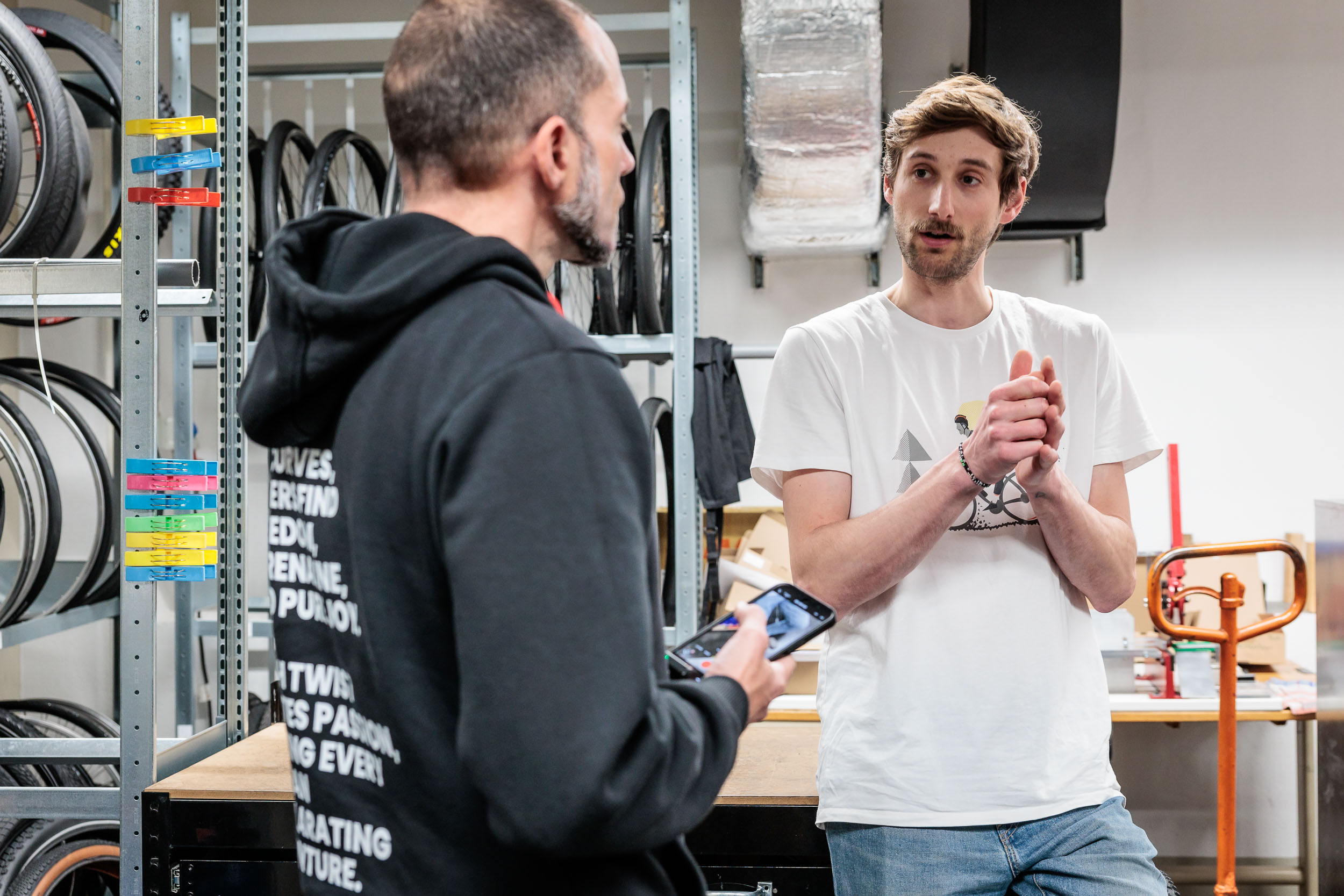


What followed was no rush job, but several years of development. Combining a mechanical engineer’s perspective with a chemist’s knowledge, Kertész and Lembacher set out to find a material superior to the conventional bicycle tube: lighter, more compact and more resistant.
The result is called Tubolito. And although they did not invent thermoplastic polyurethane (TPU), they were the first to give it a new level of relevance and visibility in the cycling sector.
| Year | Manufacturer | Portfolio |
|---|---|---|
| 2011 | Eclipse | TPU in a bicycle tube? Swiss company Eclipse got the ball rolling in 2011, becoming the world’s first supplier to use thermoplastic polyurethane in a bicycle tyre. However, the technology was slightly ahead of its time: functional issues prevented a major breakthrough. |
| 2016 | Tubolito | The Austrian company launches its first TPU bicycle tubes – light, robust, compact and with low rolling resistance. |
| 2017 | Revoloop | Launch of the first REVO TPU road bike tubes. Models for gravel and urban bikes follow in 2018, with MTB versions finally arriving in 2019. |
| 2020 | Schwalbe | Launch of the Aerothan tubes on 8 October 2020. Developed together with BASF, they are made entirely from Elastollan and are 100% recyclable. |
| 2020 | RideNow | Wide selection of lightweight TPU tubes in the lower to mid-price range. |
| 2021 | Pirelli | In 2021, Pirelli unveils the SmarTUBE, its first TPU tube – developed with a manufacturing partner and packaged in the brand’s signature yellow and black. |
| 2021 | M-Wave | For beginners and occasional users – products in the lower price range. |
| 2022 | Vittoria | Lightweight TPU tubes for road and gravel. A fairly limited portfolio, with little choice particularly in the MTB segment. |
| 2024 | Continental | ContiTPU is unveiled in spring 2024 – a seven-layer TPU tube focused on air retention and durability. |
| 2025 | Aeron | RTI Sports presents the Aeron/TPU brand at Eurobike 2024. Series production of the SuperLite Race models with aluminium valves is scheduled to begin later this year |

What is TPU – and why use it at all?
Before we delve deeper into the Tubolito story and company profile, it is worth taking a brief look at the material itself.
Many people primarily associate TPU with racers, weight weenies or connoisseurs. Depending on the compound and dimensions, however, TPU offers undeniable benefits not only to the performance crowd mentioned above, but can also bring tears of joy to commuters, touring cyclists and even BMX riders – particularly when compact packing size, puncture resistance or simply less stressful handling during a tube change matter.
TPU stands for thermoplastic polyurethane – a material that sits somewhere between rubber and high-tech plastic. It is flexible, tear-resistant and mouldable, yet extremely light and surprisingly durable. It has long been standard in industry wherever conventional materials reach their limits – so it was only logical that sooner or later it would be repurposed for bicycle tubes.


The advantages of TPU over butyl and latex:
► Weight: TPU tubes are true minimalists. A conventional butyl tube generally weighs 100 to 120 grams, while a Tubolito – depending on the model – can weigh less than 23 grams (e.g. S-Tubo Road). That makes it the material of choice for weight obsessives.
► Packing size: TPU tubes fold down extremely small – ideal for a saddle bag, jersey pocket or even the tiniest frame bag.
► Air retention: Roughly comparable to thick butyl. You do not have to keep pumping them up – unlike latex tubes or TLR systems.
► Rolling resistance: Tests show that TPU tubes often produce measurably less rolling resistance than butyl. They do not quite match latex, but come very close – while being significantly more practical for everyday use.
► Puncture resistance: TPU’s high tear resistance and tough nature make it more resistant to punctures and pinch flats.
► Sustainability: Many TPU tubes (e.g. from Tubolito or Schwalbe) are fully recyclable – an environmental advantage they can justifiably claim.

The other side of the coin
► Installation: TPU tubes require more care during installation than ordinary butyl ones. If you handle tyre levers roughly, you risk causing tiny tears – and leaks later on.
► Puncture repair: Unlike butyl, TPU can be patched on the road, but the repair is not always reliable. Many users therefore prefer to carry a spare tube and repair the damaged one later at home, without any rush.
► Ride feel: Some riders report a slightly “harsher” ride. TPU tubes provide less damping than latex and feel stiffer than butyl. Noticeable? Perhaps. Psychological? Definitely.
► Price: TPU is not cheap. While a butyl tube costs between 6 and 10 euros, TPU models often cost 20 to 40 euros. So they are unlikely to appeal to bargain hunters.


Tubolito company profile
Tubolito GmbH was founded in 2016 by the two Viennese founders Ákos Kertész and Christian Lembacher. Drawing on their expertise in mechanical engineering and materials science, they developed innovative bicycle tubes made from thermoplastic polyurethane (TPU), distinguished by their low weight and high durability.
Like a classic young start-up, the company began developing its first prototypes in a small office in Vienna’s third district, initially testing them on the founders’ own bikes. Step by step, the tubes were presented to selected specialist bike shops in Vienna and distributed among high-mileage riders from various cycling clubs. They were tested, destroyed, analysed and improved. Gradually, more and more shops took notice, and more and more consumers began riding with the distinctive orange tubes.
The company’s headquarters have been located on Pottendorfer Straße in Vienna’s 12th district since autumn 2020. This is where its research, development, marketing and company management are based. Tubolito currently employs 16 people.
The TPU tubes are produced in Sopron, Hungary, close to the Austrian border. This location enables efficient manufacturing and logistics within Europe.



Interview with the two Tubolito founders
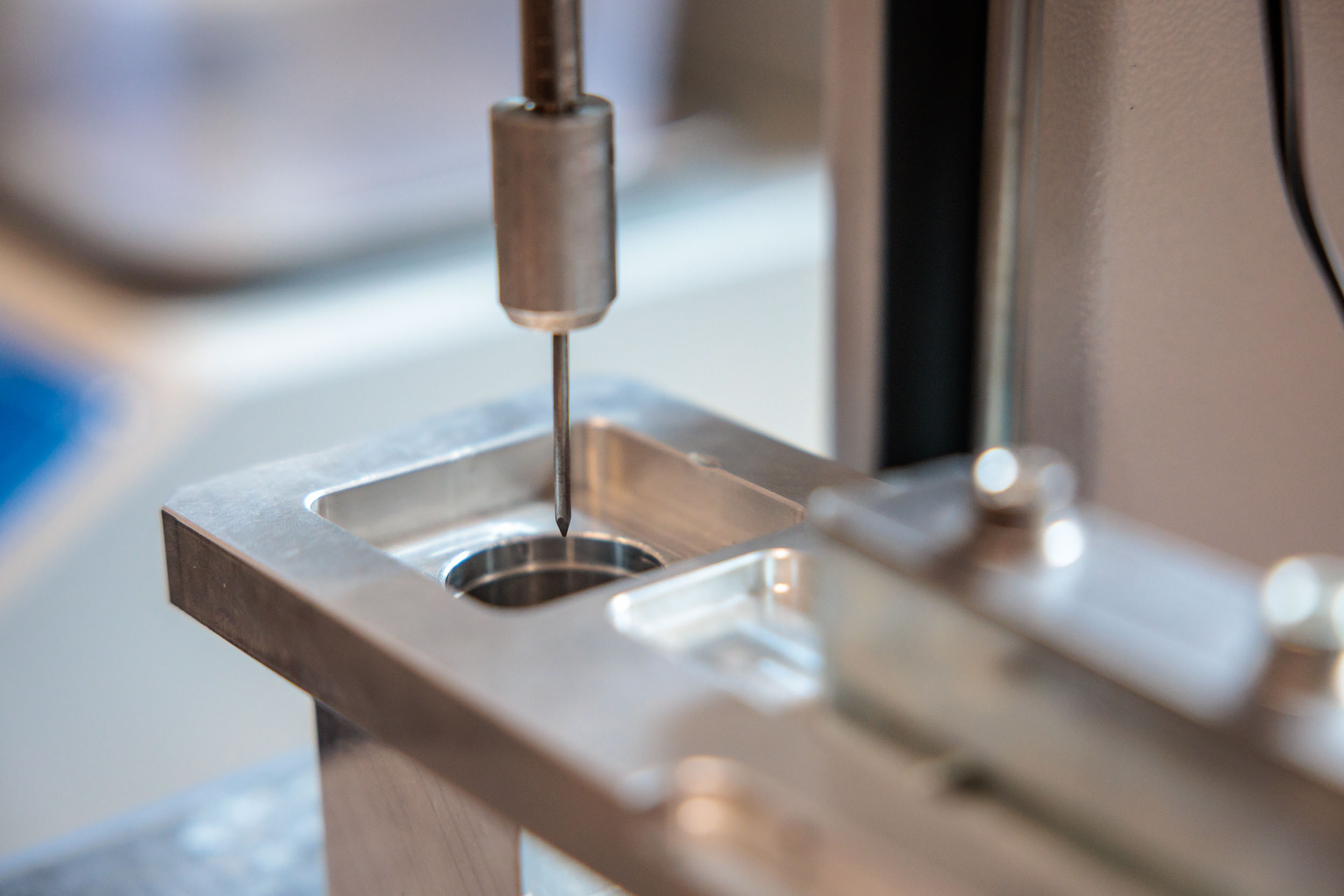
Bikeboard: How did you manage to break into specialist retail at home and abroad, as well as the major online shops? Was it a hard-fought battle – or had the market been waiting for you?
Tubolito: It was almost a stroke of luck: on one of our road trips, we got talking to the Mountainbiker.at team, who used our tubes in mountain bike marathons – and rated them highly. The decisive push ultimately came from Martin Rösner, who said: “That could be one for Pancho.” (Editor’s note: He was referring to Johann Pöllmann, nicknamed “Pancho”, managing director of Bike+Sports GmbH – an experienced wholesaler and wheel specialist.)
At the time, Pancho was already distributing TPU tubes from another manufacturer, but was not entirely satisfied with their reliability. He was correspondingly cautious at first – until his team riders tested our products themselves in Bad Goisern. The result: Tubolito was added to the range and the ball started rolling. Bike+Sports has been our exclusive partner for Austrian specialist retailers since 2016.
A distribution partner for Germany followed shortly afterwards, and major online shops such as Bike24, Bike-Components and R2-Bike also quickly came on board. Our first appearance at Eurobike in 2017 really accelerated the development – today, Tubolito tubes are available worldwide.


Bikeboard: Why are your tubes actually orange?
Tubolito: Thermoplastic polyurethane can essentially be coloured in any conceivable shade – so it was a very deliberate choice. It was important to us to establish a colour that not only looked good in our eyes, but also had a sporty, dynamic character while being easy to process.
Even back then, yellow and red were already strongly associated with major tyre manufacturers – too generic or visually “worn out”. So we chose a distinctive orange: eye-catching, individual and highly recognisable. Initially, not only the tube itself but also the entire valve body was orange – which certainly got people talking.
We have since expanded our range: style-conscious road cyclists can now also choose black valves, while limited green versions cater for those who like to add a splash of colour. Nevertheless, orange remains our trademark – because if you ride Tubolito, there is no reason to hide it.


Bikeboard: Just how thorough is your quality control? Do you inspect every batch or actually every single product?
Tubolito: Our quality control starts with the valve: once the threaded core has been glued in place, every single valve is checked for leaks – only then does it proceed to tube assembly.
The finished tube – cut to length, welded and bonded – is also individually leak-tested before it goes into the box. In addition, we take random tube samples from every production batch and subject them to intensive testing on our test machines.
These include accelerated durability tests that simulate a Tubolito tube’s complete “lifetime cycle” in just three days. The entire batch is only released once these samples meet the requirements.
We have also been ISO 9001 certified since 2021 – which means annual external audits that put all our operational processes, from production to documentation, under the microscope. For us, quality is not a buzzword, but an integral part of the production process.


Bikeboard: You offer free replacement within one year for defective X-Tubo tubes. How long do you intend to maintain this service – particularly if sales continue to rise?
Tubolito: The return rate for the X-Tubo models – our particularly robust versions for e-MTBs, gravel bikes and trekking bikes – is pleasingly low. In other words, the products deliver what they promise. So we currently see no reason to discontinue the replacement service.
The administrative workload should not be underestimated, but much of the process is now automated and handled exclusively through prior product registration. This keeps the workload manageable – regardless of how many tubes are sold.

Bikeboard: Schwalbe has caused quite a stir with its new Clik valve system. Will you also be adopting this open standard?
Tubolito: Technically, it would be entirely possible to equip our tubes with the Clik-Valve system at the factory – suitable prototypes already exist and work very promisingly.
However, Schwalbe currently holds five-year exclusivity for the Clik valve in Europe. For legal reasons, we are therefore not permitted to bring Tubolito tubes using this system to market during that period.
Whether and when this becomes possible ultimately depends on Schwalbe offering us an appropriate licence or an opportunity to collaborate. In any case, we are in contact – and we are staying on it.

Bikeboard: Do all the new TPU brands and manufacturers from Europe and Asia give you a headache?
Tubolito: No – that is part of the game. Of course, sometimes you wish you had a patent that would protect you indefinitely. But that is not how the market works, especially in a high-growth segment like ours.
It was clear to us from the outset that sooner or later, more suppliers would enter the market. And honestly, the fact that more and more manufacturers are now turning to TPU validates the path we have taken. We created a market that did not previously exist in this form – now it is up to us to extend our lead. And we are convinced that we are still only at the very beginning.
What sets us apart from the competition is not only our experience, but also the breadth of our portfolio: with S-Tubo, Tubo and X-Tubo, we cover a wide variety of uses – from road bikes and gravel to e-MTBs. Our integrated PSENS system also offers an innovative feature that is unique to us.
Then there are our strong testimonials – from the BMX racing segment, for example, as well as the Hrinkow team and international UCI riders who rely on our tubes. Another genuine unique selling point is our one-year replacement programme for X-Tubo models, including systematic analysis of the tubes sent back to us – this is not just about service, but also continuous product development.
And last but not least, we have also long been established at OEM level – with partners such as Brompton, Bianchi and Canyon. Unfortunately, KTM is still missing – Austria and orange, of all things! But never mind: some things simply take a little longer. For us, it remains a matter close to our hearts.
Bikeboard: Will your focus remain on bicycles – or are you already considering using TPU in other areas?
Tubolito: Bicycles will very clearly remain our main focus – both in terms of development and sales. Nevertheless, there are already some initial projects beyond cycling: we produce red TPU tubes as an OEM solution for a major motocross manufacturer, and aftermarket products for this sector are also being planned.
We are also working on further innovations – including developments around our PSENS system. We see potential for new applications here, but bicycles will remain our core market.


Tubolito's in-house test rigs
Tubolito's in-house laboratory is located directly below its Vienna office and is equipped with everything needed for meaningful stress testing. Its proximity to the development department allows for direct communication and rapid response times. New ideas, material adjustments or design changes can therefore be checked and optimised without delay. A wide range of scenarios are simulated here under controlled conditions - realistic, repeatable and consistently documented.

 #1 Service-life test under realistic conditions
Varying pressure, temperature and humidity levels simulate the ageing process of the TPU material in fast motion.#1 Service-life test under realistic conditions
Varying pressure, temperature and humidity levels simulate the ageing process of the TPU material in fast motion.
 #3 Endurance test under standard load, including brake simulation
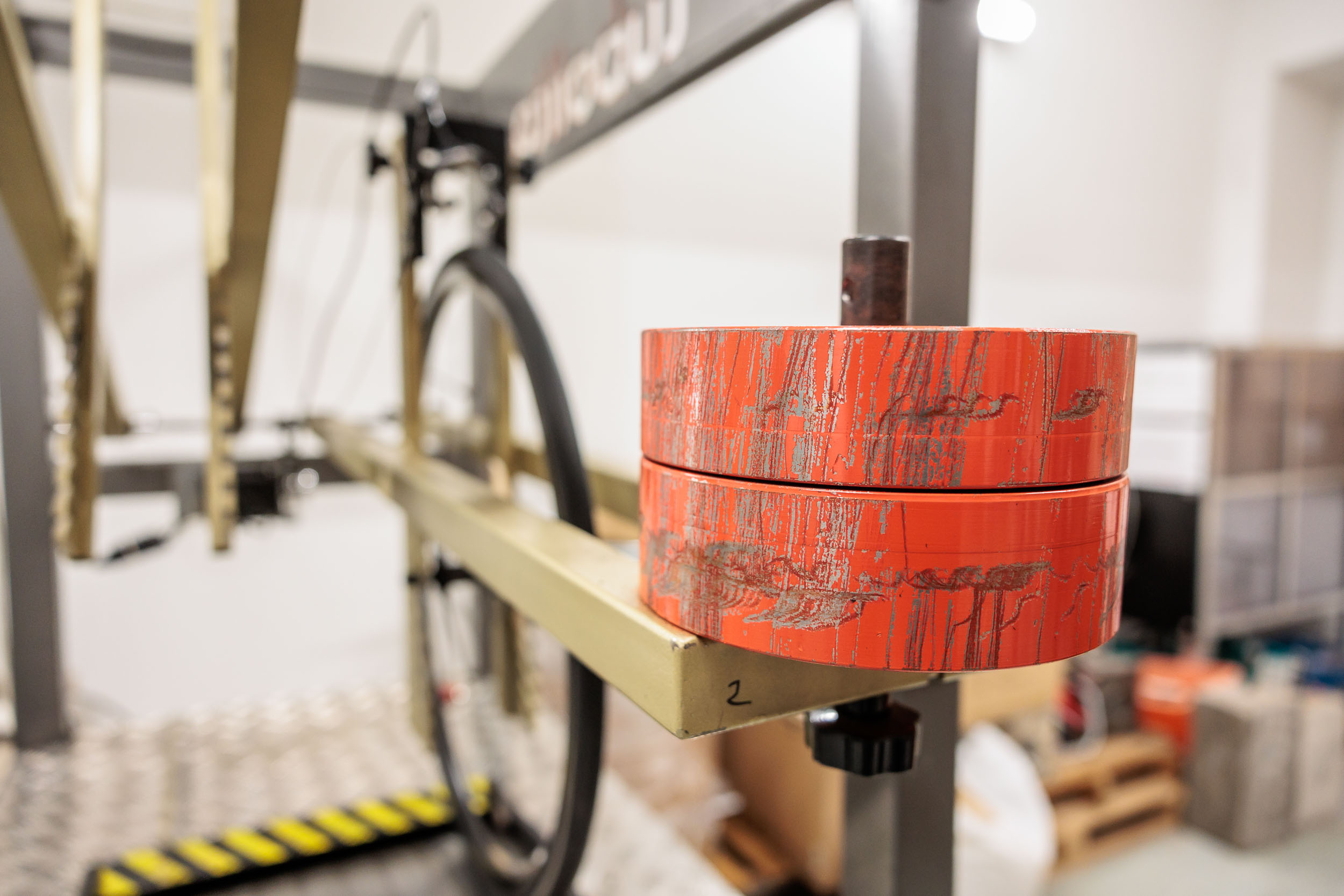
Three-day endurance test at a constant 25 km/h, 7 bar tyre pressure and 40 kg wheel load. Optional braking cycles alternate between braking and pauses, with temperatures at the aluminium rim reaching up to 100 °C.#3 Endurance test under standard load, including brake simulation
Three-day endurance test at a constant 25 km/h, 7 bar tyre pressure and 40 kg wheel load. Optional braking cycles alternate between braking and pauses, with temperatures at the aluminium rim reaching up to 100 °C.
 #4 "Bumper" endurance test for MTB & gravel
Simulation of steps, kerbs and other uneven surfaces: 24 hours of continuous operation at 25 km/h, 2 bar tyre pressure and a load of 40 kg per wheel.#4 "Bumper" endurance test for MTB & gravel
Simulation of steps, kerbs and other uneven surfaces: 24 hours of continuous operation at 25 km/h, 2 bar tyre pressure and a load of 40 kg per wheel.


 #5 Puncture test - nail ramp under real-world conditions
Practical test using a real nail ramp - highly realistic, but with limited reproducibility. Nail height and spacing can be adjusted individually.#5 Puncture test - nail ramp under real-world conditions
Practical test using a real nail ramp - highly realistic, but with limited reproducibility. Nail height and spacing can be adjusted individually.
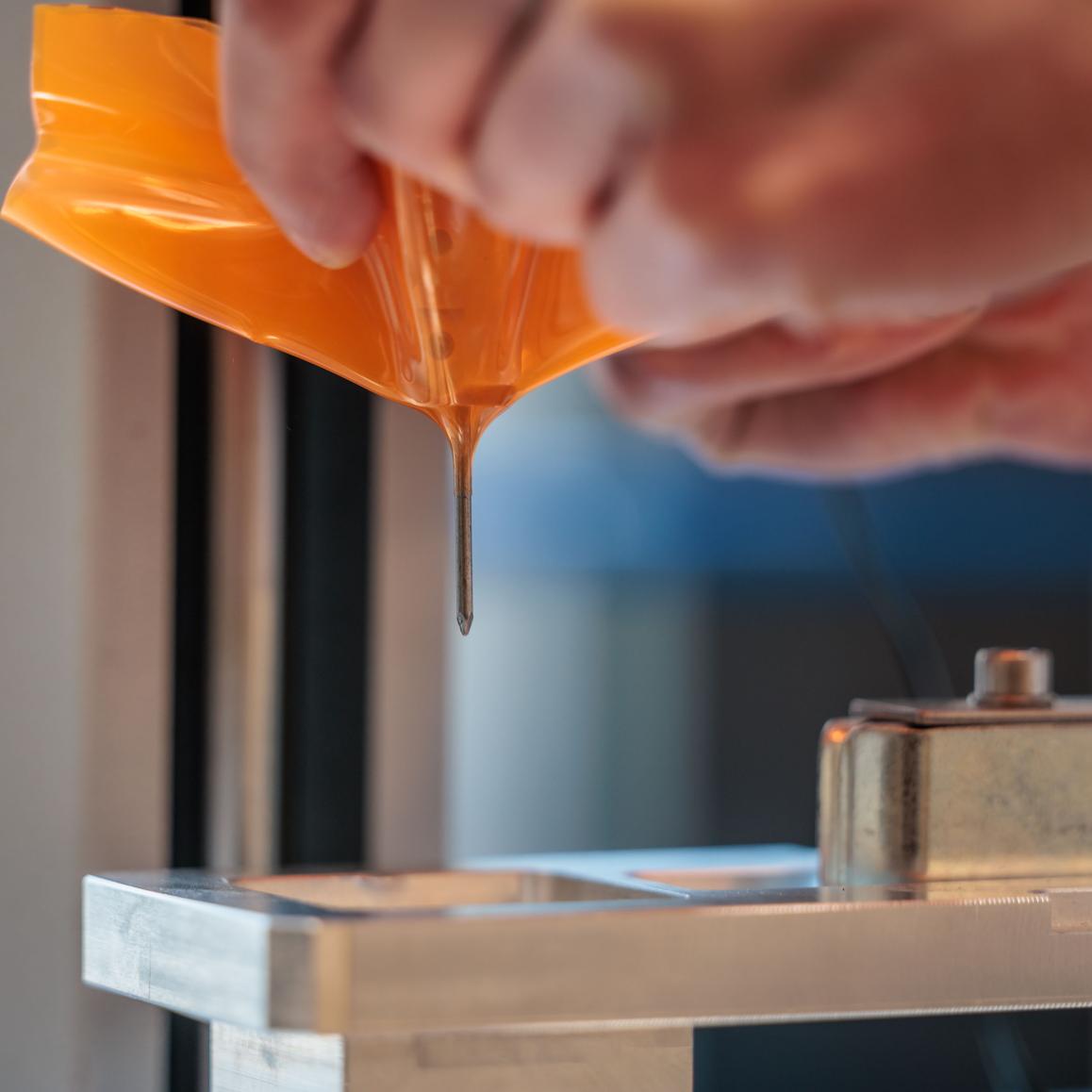 #6 Puncture test - test rig with a defined nail impact
A proprietary test setup with a realistic nail profile instead of a standardised ISO tip. More than 600 individual measurements documented by an in-house test engineer.#6 Puncture test - test rig with a defined nail impact
A proprietary test setup with a realistic nail profile instead of a standardised ISO tip. More than 600 individual measurements documented by an in-house test engineer.
 #7 Tensile test with stress-strain analysis
A strip of TPU is stretched at a defined speed until it tears. The resulting stress-strain curve is evaluated to assess elasticity and load-bearing capacity.#7 Tensile test with stress-strain analysis
A strip of TPU is stretched at a defined speed until it tears. The resulting stress-strain curve is evaluated to assess elasticity and load-bearing capacity.


Questions from Bikeboard users
Bikeboard user Carver asks: In the event of a puncture, can you also use self-adhesive patches from third-party manufacturers? If so, which ones?
Tubolito: We only test our own Tubolito Patch-Kit and therefore cannot make any substantiated statement about the compatibility or durability of repair kits from other manufacturers.
What we can say with certainty is that our Patch-Kit was developed specifically for our TPU tubes, has been extensively tested and works reliably - both on the road and for repairs at home.
Bikeboard user BikeBär asks: Why shouldn't the adhesive from the Tubo Patch-Kit be applied to both surfaces - especially since it is Camplast by Rema Tiptop, for which double-sided application is recommended in other uses?
Tubolito: That is a valid question and one we are happy to address. The adhesive included in the Tubo Patch-Kit - Rema Tiptop Camplast - was tested together with Rema's chemists specifically for use with TPU tubes. The recommendation to apply it to one side only is based on these tests, which showed that applying it solely to the surface of the tube provides the necessary adhesion.
There is also a practical reason for this recommendation: applying the adhesive to one side makes the patch easier to control, and your fingers do not become sticky as quickly - not an insignificant point, especially when making repairs on the road.
However, it is fundamentally correct that the adhesive chemically softens the TPU surface to create a stable bond. And yes, applying it to both surfaces also works technically, particularly with thicker materials such as tarpaulins, inflatable boats or air mattresses, where both the base material and the patch are substantially thicker.
In short, our recommendation is based on practical testing and handling with our tubes - but if you have had good results applying it to both surfaces in a particular case, you are not doing anything fundamentally wrong.

Bikeboard user punkti asks: How important is recycling to you – beyond the marketing claims? And what is the actual proportion of recycled material in your tubes?
Tubolito: Recycling is genuinely important to us – not just as a sales argument, but as part of our long-term responsibility for our products. We are working on it at two levels. One is our take-back scheme through specialist retailers. We accept not only our own tubes, but also tubes from other manufacturers, provided they are made from TPU.
We also consistently recycle scrap from our own production process (post-industrial waste). A partner company processes it into new TPU granulate which, after colouring, is primarily used in other industries, for example to manufacture shoe soles.
At present, this recycled material is not yet being fed back into the production of our tubes – so the current recycled content is zero per cent. Smaller quantities of the granulate are reused by our research department, with the aim of producing new tubes from recycled material in future. That is a long-term goal we are actively working towards.
In short, we are not yet where we want to be – but we are doing more than just talking about it.
Bikeboard user punkti asks: Since you manufacture in the EU, how are you dealing with the issue of a PFAS ban?
Tubolito: PFAS is currently not an issue for us. Our TPU tubes do not contain PFAS, nor do we use any such substances in production. It therefore affects neither our manufacturing process nor the product itself.


Bikeboard user GrazerTourer asks: Can I safely mount my emergency Tubolito tubes directly to the frame without a cover, for example under the down tube, without having to wrap them in a Hofer carrier bag?
Tubolito: Unfortunately, we cannot recommend this across the board - too many factors depend on the specific mounting conditions. UV radiation is generally not a problem for our TPU tubes. Direct contact with the frame is more critical, however, particularly when dirt, dust or vibrations are involved. Friction over an extended period can cause mechanical damage, the risk and effects of which are difficult to predict.
If you want to play it safe, you should give the tube additional protection – although a simple bag is not always sufficient. Plastics with a high plasticiser content can be problematic because these substances can migrate into the TPU and alter its properties. It is best to wrap a soft piece of fabric around the tube before placing it in the plastic bag.
Bikeboard user roland_p asks: How UV-resistant are Tubolito tubes? Should you carry them in light-proof packaging, such as inside a saddle bag, or will they also last indefinitely in a transparent bag?
Tubolito: Based on current knowledge, UV exposure is not a relevant issue for our tubes. Although we do not have specific long-term figures, TPU is generally considered significantly more UV-resistant than conventional rubber compounds. This is precisely why it is increasingly used for seals in the automotive industry, often replacing rubber because of its greater resistance to UV and ozone.
In practice, this means that a Tubolito tube carried in a transparent bag or loose in a saddle bag does not necessarily require light-proof packaging. However, if you want maximum longevity or carry the tube on the bike frame for months at a time, you are on the safe side with a simple cover that minimises exposure to light and friction, such as a fabric pouch or tool roll.

Bikeboard user bbkp writes: I am somewhat unhappy about the bonded-in valve cores. A pneumatic sealant – similar to a thread-locking compound – worked perfectly for me, while still allowing the core to be replaced.
Tubolito: We understand the desire for replaceable valve cores – and we did in fact test a wide range of adhesives during the development phase. However, we also had to take global requirements into account: our tubes are used in regions with extremely high humidity, intense heat, severe cold and, in some cases, significantly higher atmospheric pressure than in Central Europe.
Ultimately, a high-strength adhesive proved to be the best solution – not only in terms of absolute airtightness, but also reliable curing with the shortest possible waiting time. To achieve maximum functionality and worldwide reliability, we deliberately chose this option – even though it means the valve core can no longer be replaced afterwards.
Bikeboard user lizard asks: How long can I use a Tubolito? Mine has been in my road/gravel bike for more than two years – I don't want it to implode on a descent due to ageing.
Tubolito: There is no need to worry – our tubes do not have an “expiry date” in the conventional sense. TPU is an extremely age-resistant material and, unlike butyl or latex, does not exhibit the typical embrittlement effects over time.
As long as the tube is undamaged and remains airtight, there is no technical reason why you should not continue using it – even for several years. Of course, regular visual and pressure checks are still always worthwhile.


Bikeboard user BikeBär asks: Is it just a subjective impression, or is there a genuine basis for Tubolito/TPU having less tendency to fail suddenly and better run-flat characteristics due to its inelastic properties? That would surely be an interesting selling point.
Tubolito: Your observation is certainly understandable - and in certain scenarios it can also be substantiated technically. TPU is significantly tougher and more tear-resistant than butyl or latex. This is also reflected in independent puncture tests, in which our tubes regularly achieve very good results. TPU offers greater puncture resistance particularly at low air pressures - conditions that would be considerably more critical for conventional butyl.
However, the same applies to our products: with a classic snakebite, meaning a pinch flat caused by too hard an impact and insufficient air pressure, anything is possible - including sudden air loss. In such cases, the material properties of TPU may result in a slightly less abrupt leak, but they do not guarantee a genuine "run-flat" effect.
In short, yes, TPU can respond more robustly in certain cases - particularly with gradual damage or localised punctures. However, the issue of "run-flat capability" is complex and heavily dependent on pressure, tyre type and load. It is a genuine advantage - but not a free pass.


Bikeboard user hermes asks: Why green valves? They really don't match any bike. Surely red or blue would sell better.
Tubolito: The green valves with a flip-flop effect were intended as a limited edition – a small splash of colour for anyone who likes something a little more individual. And surprisingly, they were actually very well received. Of course, they don't match every bike – but that's precisely why we have our black valves, which work universally and are the first choice for most road cyclists.
Could red, blue or other colours follow in the future? We certainly wouldn't rule it out. Who knows – perhaps the valve range will become really colourful one day.
Bikeboard user ventoux asks: What improvements and further developments are you still working on? Where does Tubolito itself still see room for improvement?
Tubolito: In short, there are still plenty of areas we can fine-tune – and that's exactly what we're continuously working on. Our goal is to optimise every characteristic further: even more puncture-resistant, even more airtight, even lighter – and, in the longer term, more attractively priced too.
A great deal of development work is going on behind the scenes, particularly in material formulations, manufacturing tolerances and valve technology. New features – such as a further development of PSENS – are also on the list.
We're convinced that TPU as a material still has a great deal of potential – and we're nowhere near the end of its development.